This guide is part of our Commercial Cleaning Services resource library — helping facility managers stay compliant across OSHA, HIPAA, CMS, and state regulations.
What Is Commercial Cleaning?
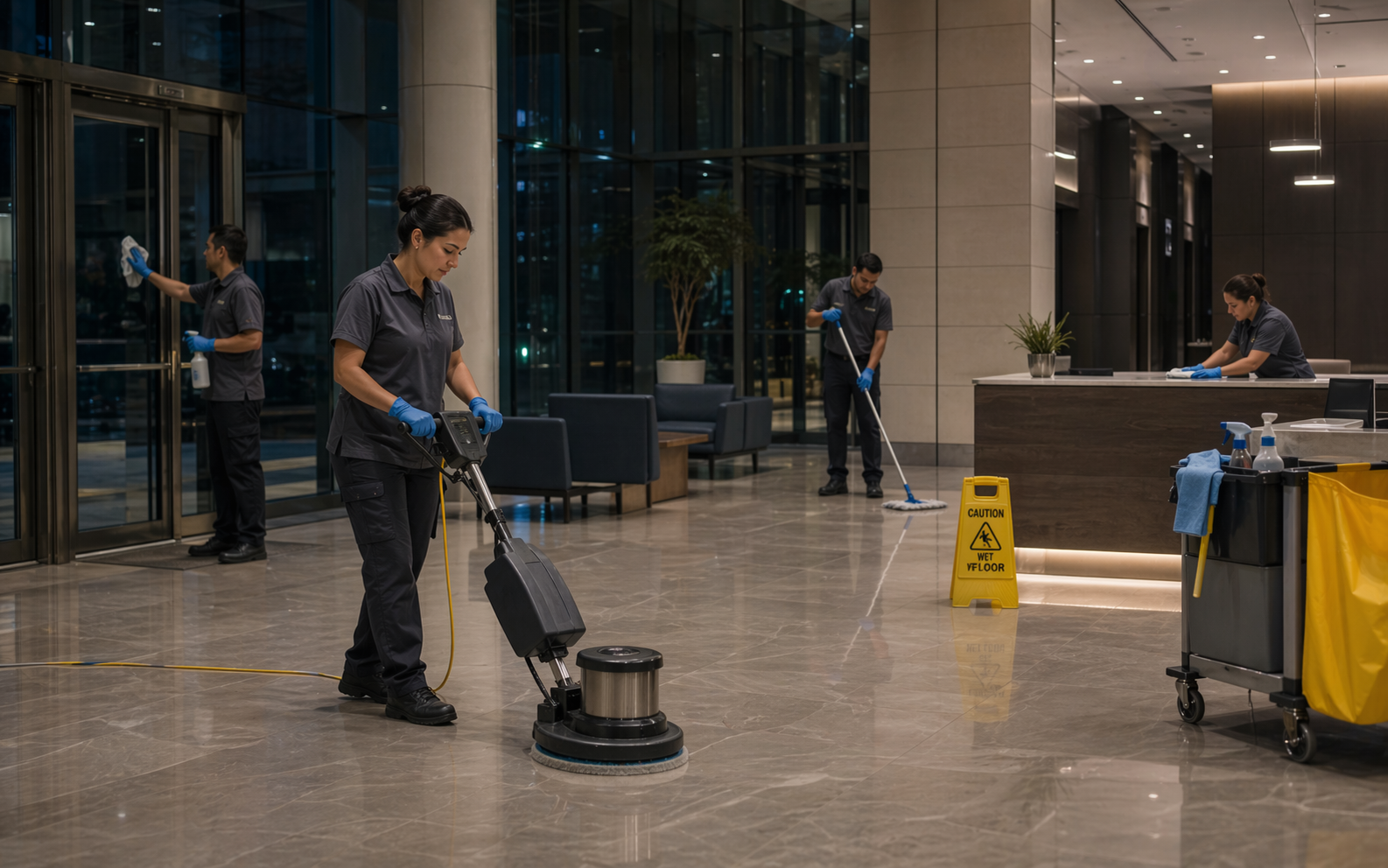
**Commercial cleaning** is the professional cleaning of businesses, offices, medical facilities, and commercial properties. Unlike residential cleaning, commercial cleaning typically occurs after business hours, involves industrial-grade equipment and EPA-registered chemicals, and must meet industry-specific compliance standards such as OSHA, JCAHO, and HIPAA. The global commercial cleaning market is valued at over $300 billion as of 2026, with over 1 million cleaning companies operating in the United States alone, according to the International Sanitation Industry Association (ISSA).
Commercial Cleaning vs. Residential Cleaning vs. Industrial Cleaning
These three categories of cleaning serve different environments and require different expertise. Confusing them leads to hiring the wrong service for your needs.
- Commercial Cleaning — Offices, medical facilities, retail stores, and professional spaces. Standard hours are typically after-hours (evenings/weekends). Uses hospital-grade disinfectants and follows compliance protocols. Pricing is typically per square foot or flat monthly rate
- Residential Cleaning — Homes and apartments. Performed during daytime hours. Uses consumer-grade products. Pricing is typically per hour or per visit. No compliance requirements
- Industrial Cleaning — Factories, warehouses, manufacturing plants, and construction sites. Involves heavy equipment (scrubbers, aerial lifts, pressure washers). Includes specialized services like high-dusting, tank cleaning, and hazmat decontamination. Highest cost per square foot due to equipment and liability
Types of Commercial Cleaning Services
Commercial cleaning includes a wide range of services. Most businesses need a combination of these, tailored to their facility type, industry, and budget.
- Janitorial Services — Daily or regular cleaning including trash removal, restroom sanitation, surface wiping, vacuuming, and mopping. The foundation of any commercial cleaning program
- Floor Care — Specialized maintenance for VCT (strip and wax), carpet (extraction and spotting), tile (scrubbing and sealing), concrete (polishing and coating), and hardwood (buffing and refinishing)
- Disinfection Services — Hospital-grade surface disinfection using EPA-registered products. Critical for medical offices, urgent care centers, and childcare facilities. Includes electrostatic spraying for large-area coverage
- Window Cleaning — Interior and exterior glass cleaning for offices, storefronts, and lobbies. Typically scheduled monthly or quarterly
- Pressure Washing — Exterior cleaning of building facades, sidewalks, parking areas, dumpster pads, and loading docks
- Day Porter Services — Daytime cleaning staff stationed at your facility for ongoing maintenance — restroom restocking, lobby upkeep, spill response, and conference room resets
- Post-Construction Cleaning — Detailed cleaning after renovation or construction, including dust removal, window cleaning, and surface finishing
- Terminal Cleaning — End-of-day deep disinfection of medical exam rooms, surgical suites, and procedure areas following CDC guidelines
How Much Does Commercial Cleaning Cost?
Commercial cleaning costs vary by facility type, size, frequency, and scope of work. These ranges are based on market data from the New York metropolitan area for 2026, which tends to run 15–25% higher than national averages.
- Per Square Foot: $0.07–$0.35 per visit depending on facility type and scope. Standard office cleaning averages $0.10–$0.18/sqft. Medical facilities average $0.15–$0.30/sqft due to compliance requirements
- Hourly Rate: $35–$60 per hour for standard janitorial work. Specialized services (floor care, post-construction) can run $50–$90 per hour
- Monthly Cost for Small Office (under 5,000 sqft): $400–$1,200 for 3x/week service including restrooms, trash, vacuuming, and surface wiping
- Monthly Cost for Medium Office (5,000–15,000 sqft): $1,200–$3,500 depending on frequency and scope. Floor care and window cleaning typically billed separately
- Monthly Cost for Large Facility (15,000+ sqft): $3,500–$10,000+ depending on facility type. Medical facilities and multi-use buildings are at the higher end
How Often Should Your Facility Be Cleaned?
Cleaning frequency depends on your facility type, foot traffic, and industry requirements. Here are guidelines based on facility type:
- Medical Offices & Healthcare — Nightly (5–7x/week). Regulatory standards require consistent terminal disinfection. High-touch surfaces need attention every night. Budget for the maximum frequency that compliance demands
- Professional Offices (law firms, accounting, insurance) — 3–5x/week depending on headcount and client traffic. Most offices with 10+ employees need at least 3x/week service to maintain presentable restrooms and common areas
- Retail Storefronts — Nightly during peak season, 3–5x/week otherwise. Customer-facing restrooms must be restocked daily
- Auto Dealerships — Nightly for showrooms and restrooms. Service bay degreasing weekly. Exterior pressure washing monthly
- Daycares & Schools — Nightly (5x/week minimum). Health department regulations typically require daily cleaning and disinfection of all surfaces children contact
- Gyms & Fitness Centers — Nightly cleaning plus daytime porters for equipment wipe-down and restroom maintenance between uses
How to Verify Cleaning Quality
The biggest challenge in commercial cleaning isn't getting a company to show up — it's verifying that they actually cleaned properly. According to industry data, up to 30% of scheduled cleaning visits have some form of quality issue, from skipped rooms to incomplete task completion.
- NFC/RFID Verification — Cleaners scan NFC tags placed in each room or zone, creating a timestamped record of every area visited. This technology makes it impossible to 'sign off' on rooms without physically being present
- Photo Documentation — Before-and-after photos submitted from the cleaning crew provide visual proof of completed work. Most effective when combined with a checklist system
- Night Manager Inspections — An independent inspector (not the cleaning crew's employer) visits after cleaning to audit quality. This eliminates the conflict of interest in self-reported quality
- GPS/Time Tracking — Confirms the cleaning crew arrived at your building, how long they stayed, and when they departed. Useful for detecting shortened visits
- Morning Reports — An automated daily summary sent to building management showing what was cleaned, what was missed, and any issues identified during inspection
Industry Standards and Certifications
The commercial cleaning industry has several important standards and certifications that indicate quality, safety, and professionalism.
- ISSA CIMS Certification — The Cleaning Industry Management Standard is the gold standard for cleaning company operations. Requires documented quality systems, training programs, and environmental responsibility. Only about 1% of cleaning companies achieve this certification
- OSHA Compliance — All commercial cleaning operations must comply with OSHA standards including the Bloodborne Pathogen Standard (29 CFR 1910.1030), Hazard Communication (GHS), and Personal Protective Equipment requirements
- Green Seal Certification — Indicates products meet environmental and health criteria. Particularly important for schools, daycares, and healthcare facilities where occupant exposure to cleaning chemicals is a concern
- GBAC STAR Accreditation — The Global Biorisk Advisory Council accreditation demonstrates a facility's preparedness for infectious disease prevention. Developed during COVID-19 and now applied broadly
- EPA Safer Choice — Products carrying this label meet EPA's strict criteria for being safer for people, pets, and the environment while still being effective cleaners
Trends Shaping Commercial Cleaning in 2026
The commercial cleaning industry is evolving rapidly. Understanding these trends helps you evaluate companies and negotiate better contracts.
- Technology-Based Quality Verification — NFC check-in systems, real-time dashboards, and automated morning reports are replacing the old 'trust us' model. Best-in-class providers now offer verifiable, timestamped proof of every clean
- Sustainable and Non-Toxic Products — Demand for Green Seal and EPA Safer Choice certified products is growing, driven by employee health concerns and tenant preferences. VOC regulations like NYS Part 226 are making low-toxicity products mandatory in some states
- Labor Shortage Adaptation — With industry turnover at 200–400%, leading companies invest in above-market wages, benefits, and career pathways to attract and retain reliable workers. This cost gets passed to clients but results in significantly better service quality
- Consolidated Facility Management — The trend toward single-vendor solutions — one company managing cleaning, floor care, pest control, and maintenance — reduces administrative burden and improves accountability
- Data-Driven Service Optimization — Using cleaning frequency data, inspection results, and complaint patterns to optimize scope and frequency rather than operating on fixed schedules. This can reduce costs by 10–15% while improving results